
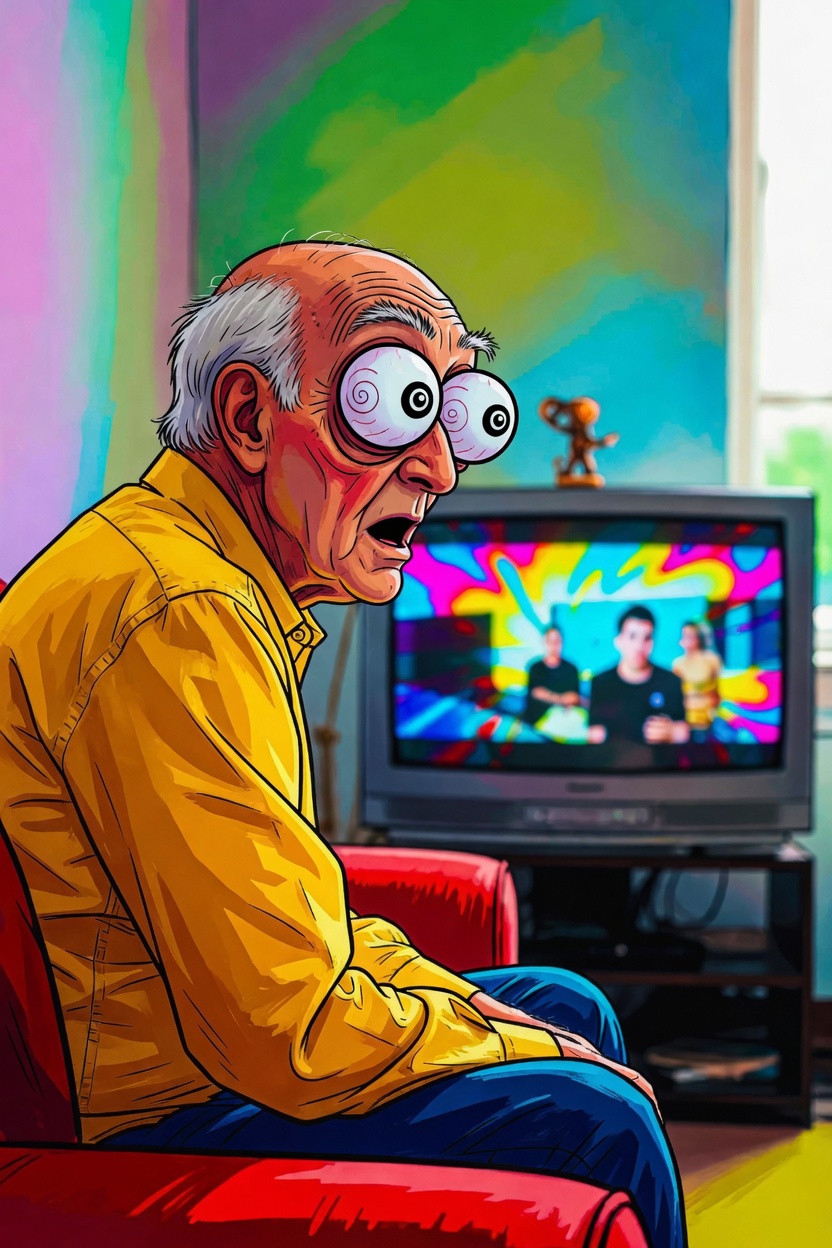
The Seed
I spent a working life around images: film that was projected and reflected, and video that was emitted. Somewhere in the middle of that career I started to suspect that the difference between those two things was not cosmetic. That it went deeper than resolution or color or contrast or “persistence of vision” and flicker/refresh. That it affected the nervous system in some other fundamental way.
While at unfinished_business, the thought returned to me after hearing about the company’s experiments in e-ink and e-paper, which included research into full-motion systems based on those technologies.1 That work was not in our local bailiwick, but the possibilities for e-paper as a display stayed with me.
I never proved the hypothesis. I’m not sure it can be proved in the strong form I once wanted. But I still think the intuition has merit, and I think it points somewhere worth going. So I’m leaving it here, unfinished, in case someone with a lab and a few more years wants to pick it up.
The intuition
Human sight evolved to read reflected light. We know the world by the light that bounces off it — the edge of a leaf, the color of a friendly eye, the shadow under a rock. Looking into the source of light was rare in human experience, and either dangerous or risky: like looking into the sun or getting close to a fire. In other words, the reflective world was the default, the thing the system was tuned to parse.
Since the advent of television, we’ve radically changed that process. From TVs to mobile devices, DataReportal’s Digital 2025 report indicates2 that we’re spending nearly half of our waking hours looking directly into emitters. Bright, near, sustained and held inches from the eye. In roughly only two human generations we have reversed our visual input from reflective to emissive. And in only the last few years have we bothered to look at what this might be doing to our brains; to our minds.
An informal test
The one piece of real evidence I have is small and informal. Using an early Emotiv EPOC headset, I ran a crude EEG comparison: the same text — excerpts from Treasure Island — read three ways. On paper. On a reflective e-ink screen. On an emissive laptop.
Paper and e-ink looked roughly alike. The laptop diverged.
The interesting result was not “the laptop is different.” The interesting result was “e-ink sided with paper.” That’s the finding that won’t let me go. Reflective digital text behaved like reflective dead-tree text. Emission could be the thing that moved the needle.
Three subjects (my wife and kids). No replication. No blinding. I know. That’s exactly why this is unfinished business and not a paper.
Objections Claude pointed out to me
Alpha waves rise whenever a person relaxes, settles, or under-stimulates. “Display produces alpha” and “person is sitting still and calm” are the same signature. The entire history of this idea — going back to the television-trance claims of the 1970s — crashes on that confound. So even a clean version of my result would only show that emissive displays produce different cortical activity, not that they produce trance, harm, or suggestibility. Those are three further claims, and the brainwave difference earns none of them on its own.
Throughout my life, I noticed that whenever a TV was on in a room, people’s eyes would be drawn to it. It was distracting in an almost hypnotic way. As kids, we’d sit slack jawed in front of it. Mom would plunk us down in front of it to keep us quiet. As an adult, I remember the old tavern experience of one black-and-white set high up at the end of the bar, and how patrons would constantly glance over at it. However, when it was off, and only the jukebox played, the conversations would appear more engaged and intimate.
Like Jerry Mander, in his book Four Arguments for the Elimination of Television,3 I spent too long, early on, addressing my emotional reaction as if it were scientific. In this case, reaching for the word “trance.” It’s a trap. It feels explanatory and it commits to a mental state I haven’t measured. Better to let the data name the state than to name it in advance.
The directions worth chasing
Without any further ado, here is the unfinished work, including the branches that might kill the idea. With a lot of “maybes” attached.
1. Find out which physical property is doing the work. “Emissive vs. reflective” bundles four things that move together in a real laptop but can be pulled apart: emission itself, flicker (backlight and refresh), luminance (sheer brightness), and spectrum (the blue-white cast). E-ink controls all four at once, which is convenient for showing a gross effect and might be useless for explaining it. One experiment could dim an emissive panel to e-ink luminance, warm its spectrum to e-ink’s, and — if you can rig it — impose a controlled flicker on a reflective surface. Whichever manipulation collapses the difference might tell you what you were really measuring. My bet is that luminance and flicker carry more weight than reflectance as such. If that’s right, it’s good news, not bad — see direction 6.
2. Separate capture from emission. I’ve long noticed that a live screen in a room pulls every eye, continually, in a way no loudspeaker ever does to the ears. It wrecks face-to-face presence. But the cause might be motion and luminance change, not emission — a flickering candle pulls eyes too; a bright static painting doesn’t. The clean test: does a blank lit panel capture gaze the way a playing one does? If a paused frame doesn’t grab you but moving footage does, then it’s exogenous attention capture by change, and emission is a bystander. Worth knowing before building a theory on it.
3. I was thinking “harm.” “Different” is not “damaging.” Captured attention is not the same as a suppressed critical faculty — being unable to look away from a screen is not being unable to disagree with it. If there’s a cost, it has to be measured, not assumed: comprehension, retention, sustained-attention performance, fatigue. Attach a behavioral endpoint or the harm claim stays decorative.
4. The fire problem. Fire relaxes most people and excites a few to the point of obsession. I used to think that supported the thesis. Now I think it complicates it: if emitted light reliably did one thing to a nervous system, fire wouldn’t fork like that. The lesson is that response to an emitter is mediated by context and disposition, not photons alone. A campfire is slow, warm, and sits in darkness; a laptop is fast, blue-white, and sits in a lit room. Calling both “looking into fire” hides the variables direction 1 is trying to isolate. It’s a good intuitional image, but not necessarily supportive of an argument.
5. Trust the film-vs-video feeling, distrust its first explanation. Projected film felt different from a big sharp emissive display, and I’d defend that perception — but projected film also differs in shutter-flicker signature, grain, contrast curve, viewing distance, and a dark room. The visceral difference is good data; “it’s the emission” is one hypothesis among several competing for it. Let the neuroscience adjudicate, not the memory.
6. The engineering bet. This is where the intuition stops being a complaint about the modern world and becomes an engineering bet. If the cortical signature tracks display physics rather than display content, then a reflective, flicker-free, low-luminance system showing video should land on the paper side of the line — even in motion. That’s testable. But it’s also where the engineering can be confounding: the tricks that make reflective displays fast enough for motion (frontlights, fast pixel switching, higher drive luminance) can quietly smuggle back the exact properties — emission, flicker, brightness — I was trying to escape. So the real question isn’t “reflective vs. emissive” in the abstract. It’s: does this particular full-motion reflective implementation preserve the paper signature, or does the speed cost destroy the thing that made e-ink paper-like in the first place?
My hoped-for conclusion
If every branch came out the way I suspect, the defensible sentence at the end is narrow:
Reflective displays — paper, e-ink, and perhaps reflective full-motion systems — recruit cortical activity closer to natural reading than emissive panels do, and for sustained use that difference has a measurable cost in attention or fatigue.
That’s a real, useful, even marketable claim, and it justifies the technology direction I cared about without overreaching. It is not “screens put us in a submissive trance and are damaging civilization.” The grand version doesn’t follow from the narrow one, and reaching for it would only hand the skeptics the debunking they’ve been performing since 1971. The narrow claim sells the display. The grand claim sinks it.
Why I’m leaving it here
I think the reflected-light premise is strong enough to deserve a real adversary — a study built to break it, not bless it. If it survives a luminance-matched emissive condition, a static-vs-moving gaze test, and a behavioral endpoint, there’s something here. If it doesn’t, we’ll have learned which sub-claim was carrying the weight, which is its own kind of progress.
The human visual system was built for a world lit by reflection. We have wrapped ourselves in emission and assumed it was free. Maybe it is. I’d just like to know — and I suspect the answer is hiding in the fact that, given the same words, the brain barely distinguished a Kindle from a paperback, but registered the laptop the moment the light changed.
Worth looking into?
If you take this up, write me. I’d like to hear how it breaks.
* A note on how this was made
This piece came out of a conversation with Claude as my AI thinking partner. I want to be open about what that means, because it’s easy to overstate in both directions.
It started as something small: I was trying to find a half-remembered research paper about displays and trance. We never found it. What happened instead was that Claude kept asking contextual questions — what kind of screen, what era, what angle — and those questions kept making me frame the thing more sharply than I had before. The questions didn’t add content. They pried content out of me. The thesis was already in me; it wasn’t co-created, it was excavated. The later work — naming the flaws, drawing on a vast literature to reframe what I’d said — was real work, but it was work in service of a thesis that was entirely mine before the partner arrived.
So this is my article. The ideas are mine. But it is sharper than it would have been alone, and the sharpening was done by a tool that turned out to be very good at asking the next question. That seems worth disclosing, and worth describing accurately, rather than either hiding it or pretending the machine and I are peers.
1 See, for example: Hiji, N., Machida, Y., Yamamoto, Y., Satoh, Y., Ootani, S., Satoh, T. and Shigemura, K. (2012), 8.4: Distinguished Paper: Novel Color Electrophoretic E-Paper Using Independently Movable Colored Particles. SID Symposium Digest of Technical Papers, 43: 85–87. https://doi.org/10.1002/j.2168-0159.2012.tb05716.x
2 Kemp, Simon. Digital 2025: Global Overview Report. DataReportal, We Are Social, and Meltwater, January 2025. https://datareportal.com/reports/digital-2025-global-overview-report
3 Mander, Jerry. Four Arguments for the Elimination of Television. New York: William Morrow and Company, 1978.